
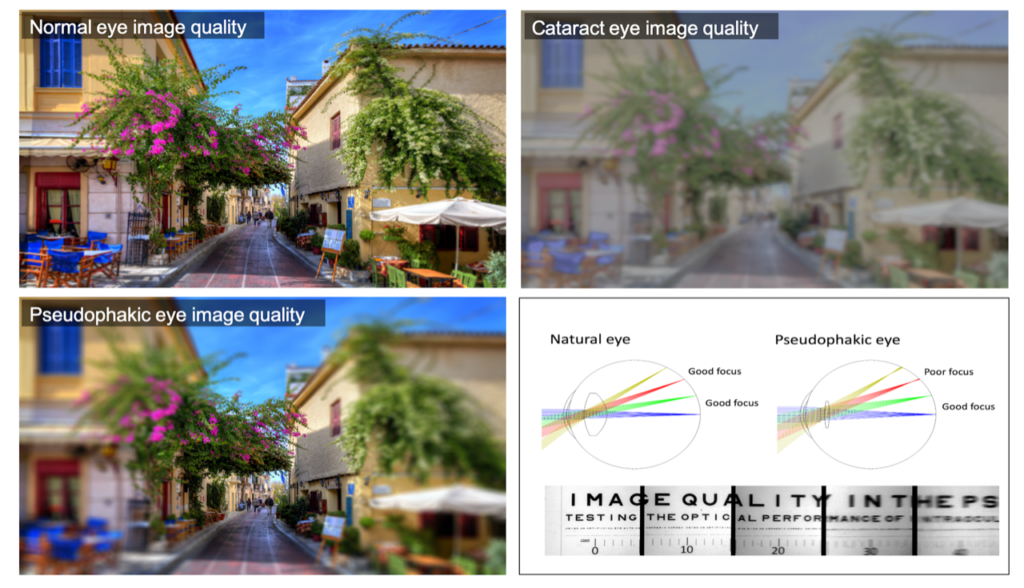
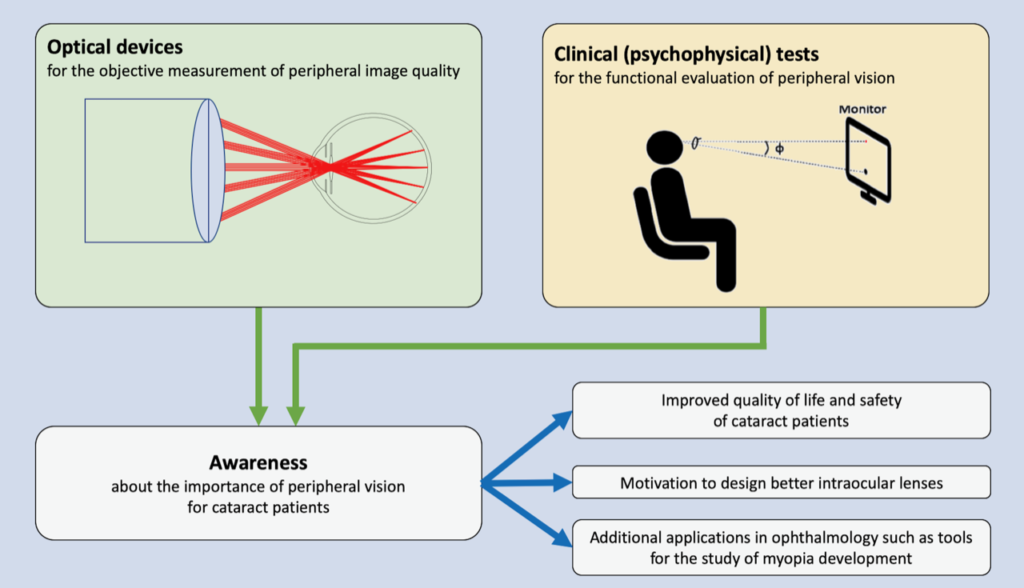
More than four million patients undergo cataract surgery each year in Europe. Cataract surgery is considered safe and effective in restoring patient’s central vision. However, there is evidence that pseudophakic eyes (i.e. the eyes of patients that have undergone cataract surgery and are implanted with an artificial intraocular lens) may have sub-optimal image quality in the periphery of their visual field. The periVIQA project pertains to the systematic modelling, measurement and analysis of peripheral image quality in pseudophakic eyes. The research team will develop optical devices and clinical tests for the measurement of this peripheral image quality and the evaluation of the implications it may have in the patients’ safety in daily tasks such as walking or driving. Raising awareness among clinicians and patients about the importance of peripheral vision may lead to better surgical planning in the future and to the design of improved intraocular lenses.
In this project the Laboratorio de Optica, Universidad de Murcia , partners with Diestia Systems, the Athens Eye Hospital, the Colour & Vision Research Laboratory, University College London and Thrust CL.
Project PeriVIQA is supported by VELUX STIFTUNG, Switzerland (project no. 1385).
